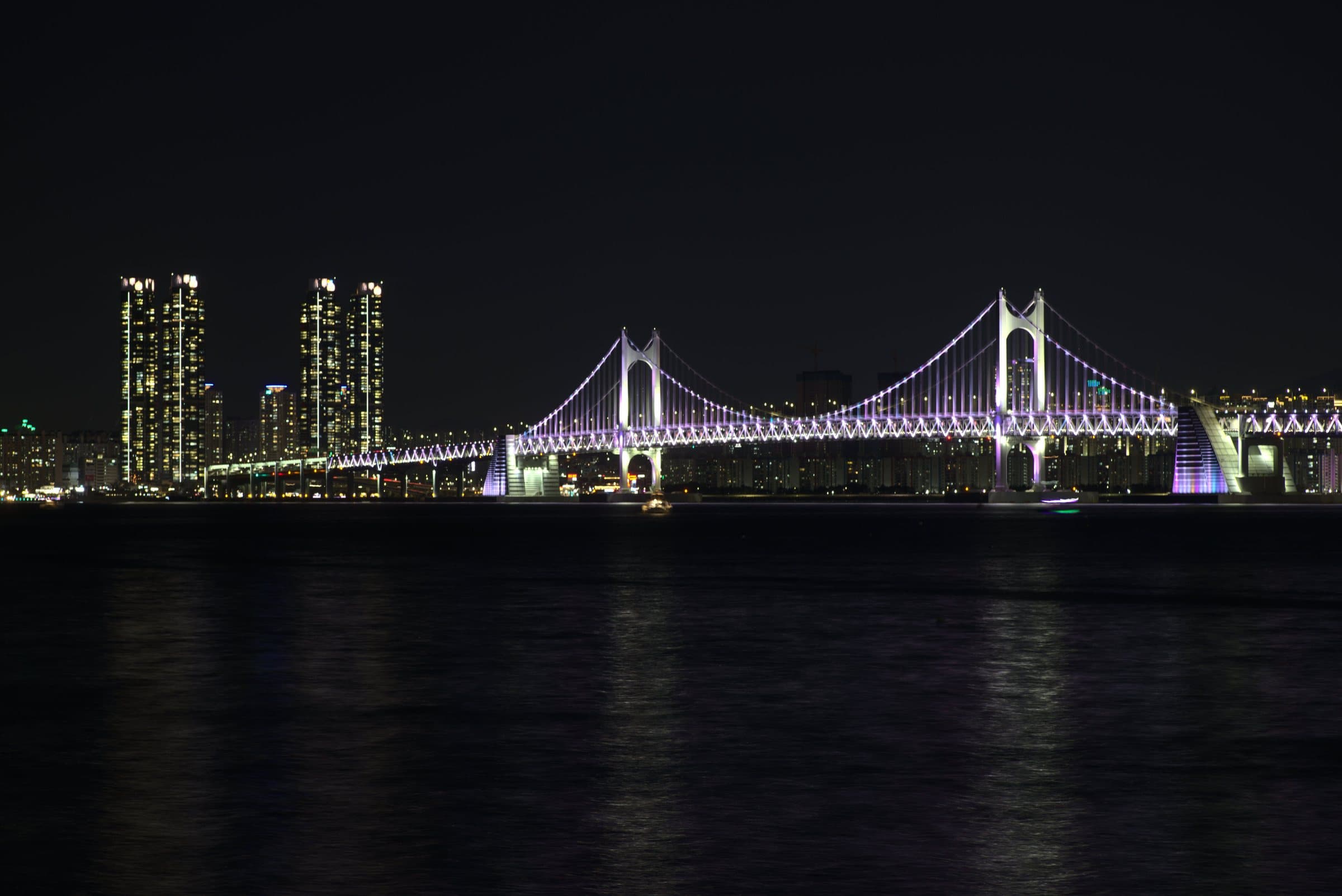
Gwangan Bridge was built to route Busan's traffic out over the water. Getting from Suyeong-gu to Haeundae-gu overland means crossing the city; drawing a straight line over the sea skips that stretch entirely. At its 2003 opening it was the longest marine bridge in the country, and it is double-decked, with the two directions stacked. That structure changes what you see from it: the upper deck opens onto the sea, while the lower sits low enough that the bridge's own steelwork feels close.
It became a sight because of the lighting. After sunset, illumination runs along the towers and cables, and a scenic lighting programme shifts colours by day of the week and by season, with special combinations for events and anniversaries. The bridge is infrastructure, but at night it turns into a device by which the city displays itself — and Busan's reputation as a night-view city owes a great deal to it.
The most familiar composition is from Gwangalli Beach. Standing on the sand, the bridge runs horizontally across your field of view with the towers of Marine City layered behind it. On summer nights people sit on the sand and simply watch it, and the cafés and restaurants lining the beach were positioned with that view in mind. For other angles, the Igidae coastal path or the Hwangnyeongsan observatory let you look down on bridge and city together.
Crossing it is worth doing too. Only vehicles are allowed — there is no pedestrian access — but driving over at night means passing between lit cables. What you can actually look at while driving is limited, though, so if seeing it is the point, the beach or an observatory serves better. Each autumn the Busan Fireworks Festival is held here, and fireworks rising with the bridge behind them is the image that defines the event.