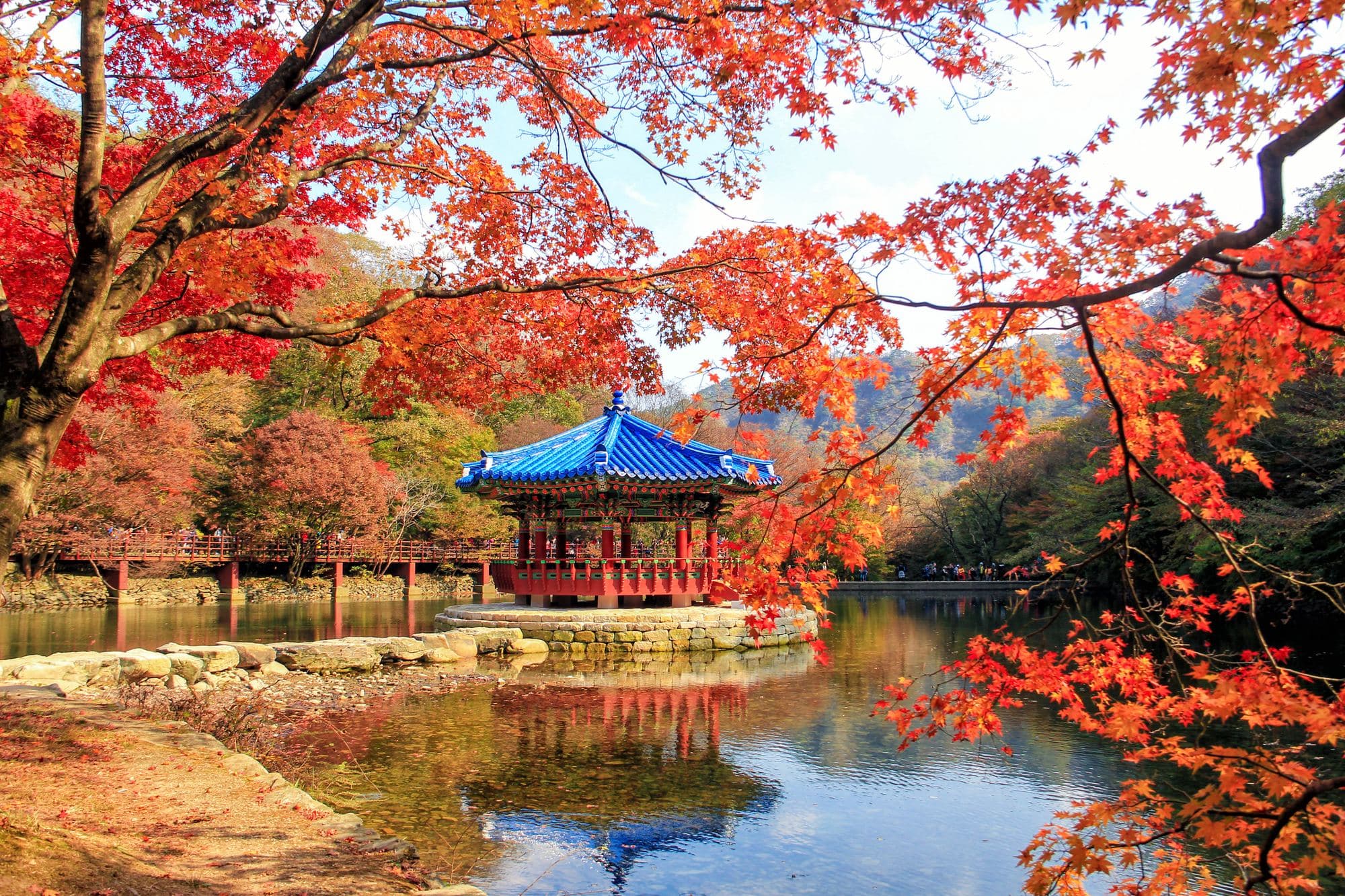
Naejangsan's reputation for autumn colour has a topographic explanation. The peaks curve inward into a horseshoe, and the valley inside that ring is deep and damp. Such places have a wide day-night temperature swing and plenty of water, which suits maples, and because the trees crowd together inside the valley the red reads as a broad, continuous surface. The name naejang is read as something hidden within — which is what the landform is.
The best-known view is Uhwajeong: an octagonal pavilion on a small pond in the valley, with the surrounding maples mirrored in the water. The bridge out to it, the red leaves and the reflection land in a single frame, which is why it photographs so well. At peak the spot is thoroughly crowded, so an early morning is the only way to a picture without people in it.
Inside the mountain sits Naejangsa temple. Maples line the road leading to it and close overhead into a tunnel; that stretch is the best walking on the mountain. A cable car climbs to an overlook where you can see the whole valley in colour from above. Queues for it grow long at peak, so it is worth deciding your walking route first.
Timing is the whole game. The colour shifts by a few days each year, with peak usually between late October and early November. Arrive too early and much is still green; too late and the leaves are down. On peak weekends traffic backs up from central Jeongeup and the car parks fill early, so a weekday visit or public transport is the better plan. Once the season passes, the crowds thin sharply and the walking is quiet.