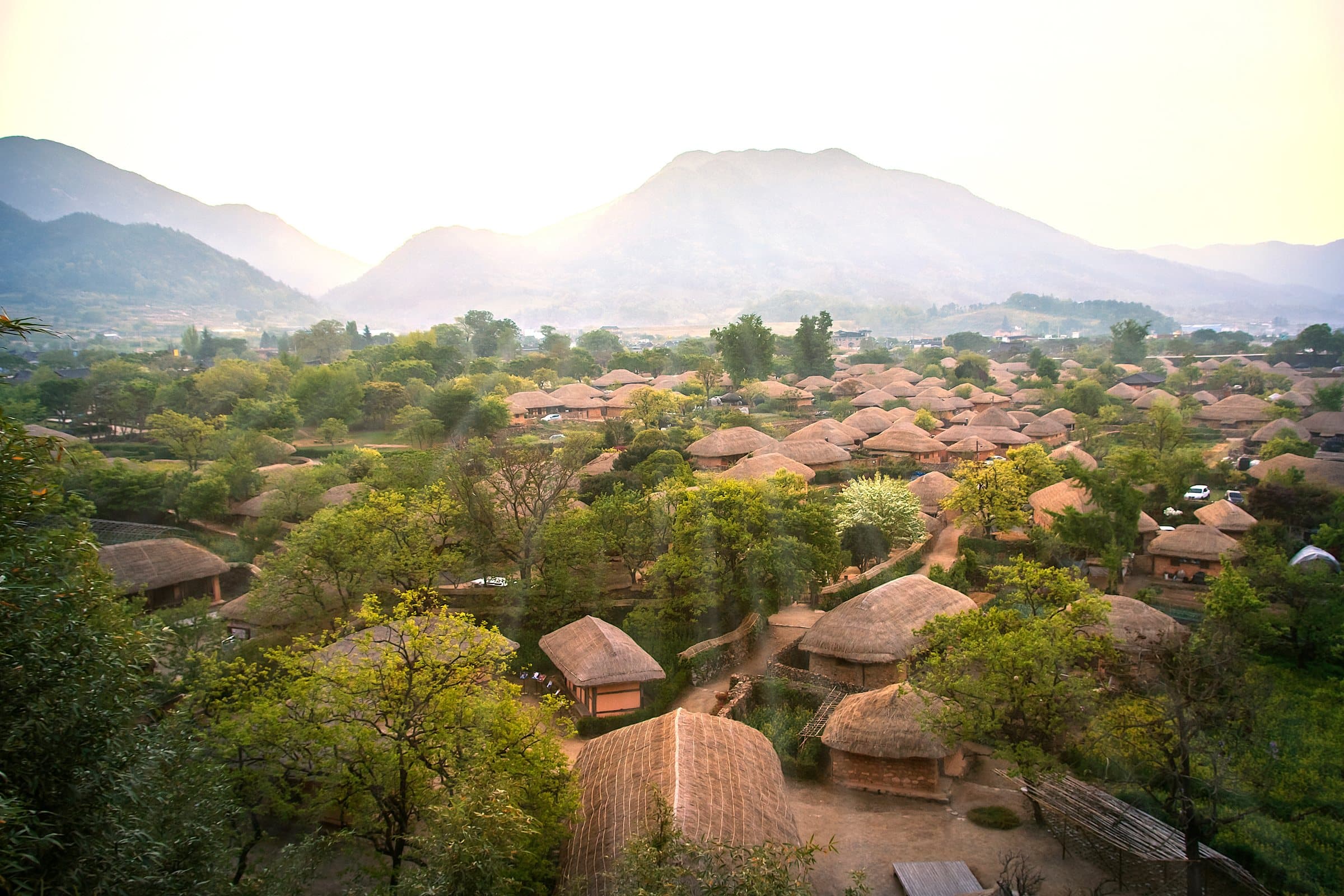
An eupseong was a walled town that handled both local administration and defence during the Joseon period. There were many across the country, but most lost their walls to modernisation, with roads and buildings taking their place. What makes Nagan exceptional is that the walls, gates, government buildings and the houses inside all survive as one piece. The rampart runs about 1.4 kilometres and is maintained for walking, so a single circuit gives you the whole village from above.
The decisive difference from other folk villages is that people live here. A good number of the hundred-odd thatched houses are actual residences, and villagers farm and go about their lives. So laundry hangs in the yards, jars sit on the terraces, and dogs bark. For a visitor this means seeing a living village; from the residents' side it means people walking into where they live, which calls for the courtesy of not stepping into yards or peering through windows.
Thatched roofs demand constant work. Rice-straw thatch decays within a year or two and has to be relaid periodically, a task called iyeong itgi. In late autumn you can see the village re-roofing together, and visiting then shows you plainly why thatch is architecture that presupposes communal labour. It contrasts with tile, which lasts decades once laid — so while thatch gets talked about as a symbol of poverty, it is in fact a structure that survives only if people gather every year.
Nagan is in Suncheon, so it is usually combined with the Suncheonman wetlands. They are about thirty minutes apart by car, and a common plan is the walled town in the morning and the wetlands for sunset. Inside the walls there are traditional games and seasonal events, and some thatched houses operate as guesthouses. Since this is a village where people live, though, the accommodation is far from modern convenience — worth knowing before you choose it.