Noodles · Gangwon
Makguksu
makguksu
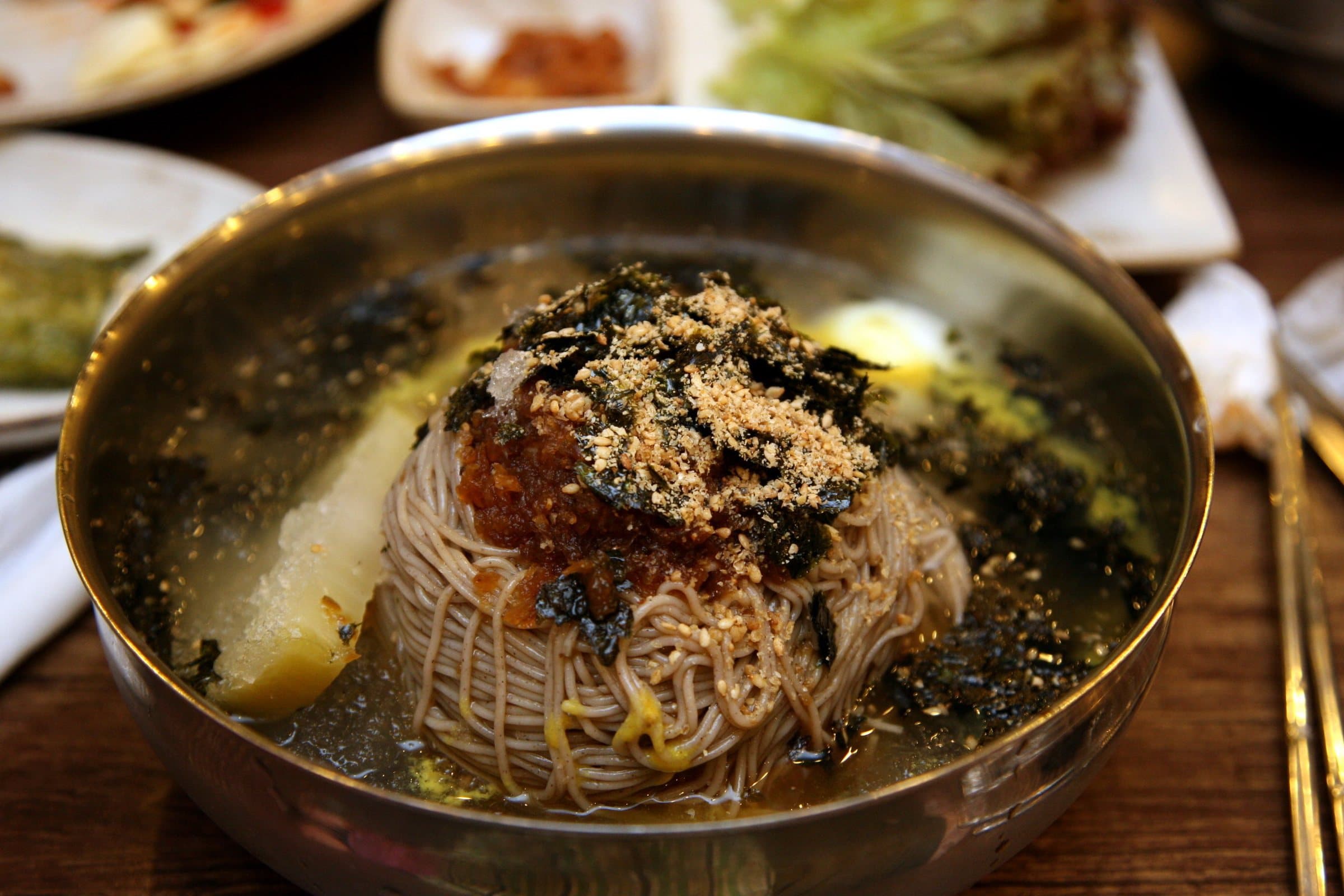
© Wikimedia Commons / Junho Jung · CC BY-SA 3.0
Makguksu is a Gangwon dish of buckwheat noodles served cold, either tossed with sauce or in broth. The mak in its name is usually read as "just now" — buckwheat noodles, unlike wheat, break apart if left standing, so they have to be eaten as soon as they are extruded. It is often compared to naengmyeon, but where naengmyeon is a refined urban dish, makguksu is closer to how mountain communities actually ate buckwheat.
Buckwheat grows in poor soil and goes from sowing to harvest in two or three months, so mountain regions where rice paddies were impractical cultivated it for centuries — which is why Gangwon is known for buckwheat dishes. But buckwheat has no gluten, so the dough will not hold together. It cannot be rolled and cut like wheat; instead the dough is pressed through a perforated press to extrude noodles. Those noodles break apart quickly once made, so they must be boiled and eaten immediately, and that property is what survives in the name.
There are two ways to eat it. The tossed version coats the noodles in gochujang seasoning with sesame oil and sugar; the soup version pours dongchimi brine or stock over them. In Gangwon it is common to do both: eat half tossed, then add broth and finish the rest as a noodle soup. There is no fixed order, and the kettle of broth many restaurants bring to the table is a service built around that habit.
The garnish is plain — shredded seaweed, sesame, half a boiled egg, julienned cucumber, and a portion of sweet-sour dressed radish, which does more work than it looks. Eaten with the noodles, the radish clears the slight chalkiness of buckwheat, and its dressing can be poured over to adjust the acidity. Mustard and vinegar usually arrive separately; rather than adding them at the start, it is better to eat half first and then adjust in small increments.
People often ask how it differs from naengmyeon. Pyongyang naengmyeon also uses buckwheat, but starch is blended in for a chewier noodle, the broth carries the dish, and it developed as a formal urban food. Makguksu runs a higher buckwheat ratio, so the noodles break more easily and eat rougher, and the seasoning tends to lead. Around Chuncheon, finishing a meal of dakgalbi with makguksu became standard, and in Gangwon travel the two are treated almost as a set.
What comes with it
- Dressed radish — sweet-sour and crisp, it clears buckwheat's chalkiness; its dressing also adjusts the acidity.
- A kettle of broth — brought so you can switch from tossed to soup halfway through.
- Mustard and vinegar — served separately; adjust in small increments after eating half.
- Dakgalbi — around Chuncheon, finishing a dakgalbi meal with makguksu is standard.
- Boiled pork — many makguksu restaurants sell it alongside; the mild sliced meat suits the noodles.
How to eat it
- 1Start tossing and eating as soon as it arrives — buckwheat noodles break and clump as they sit.
- 2Do not add mustard and vinegar at the start; eat half, then adjust in small increments.
- 3Eat the dressed radish along with the noodles — its job is to cut the chalkiness of buckwheat.
- 4Pour in the broth to turn the second half into a soup version; the kettle exists for exactly that.
- 5Noodles breaking is not a fault. With a high buckwheat ratio, that is simply how they behave.
FAQ
What does the mak in makguksu mean?
It is usually read as "just now" — as in, extruded and eaten immediately. Buckwheat has no gluten so the noodles break easily, which forces them to be boiled and served at once, and that property appears to have stayed in the name.
How is it different from naengmyeon?
Pyongyang naengmyeon also uses buckwheat, but starch is blended in for a chewier noodle and the broth carries the dish, developed as a formal urban food. Makguksu runs a higher buckwheat ratio, so the noodles break more easily and eat rougher, with the seasoning usually leading.
Should I have it tossed or in broth?
Either works. In Gangwon it is common to eat half tossed, then pour in broth and finish the rest as a soup. The kettle of broth many places bring is built around exactly that.
My noodles keep breaking — is something wrong?
No. Buckwheat has no gluten, so the noodles break easily, more so the higher the buckwheat ratio. If anything, an unusually chewy noodle can mean a lot of starch or wheat flour was mixed in.
More dishes to try
태그