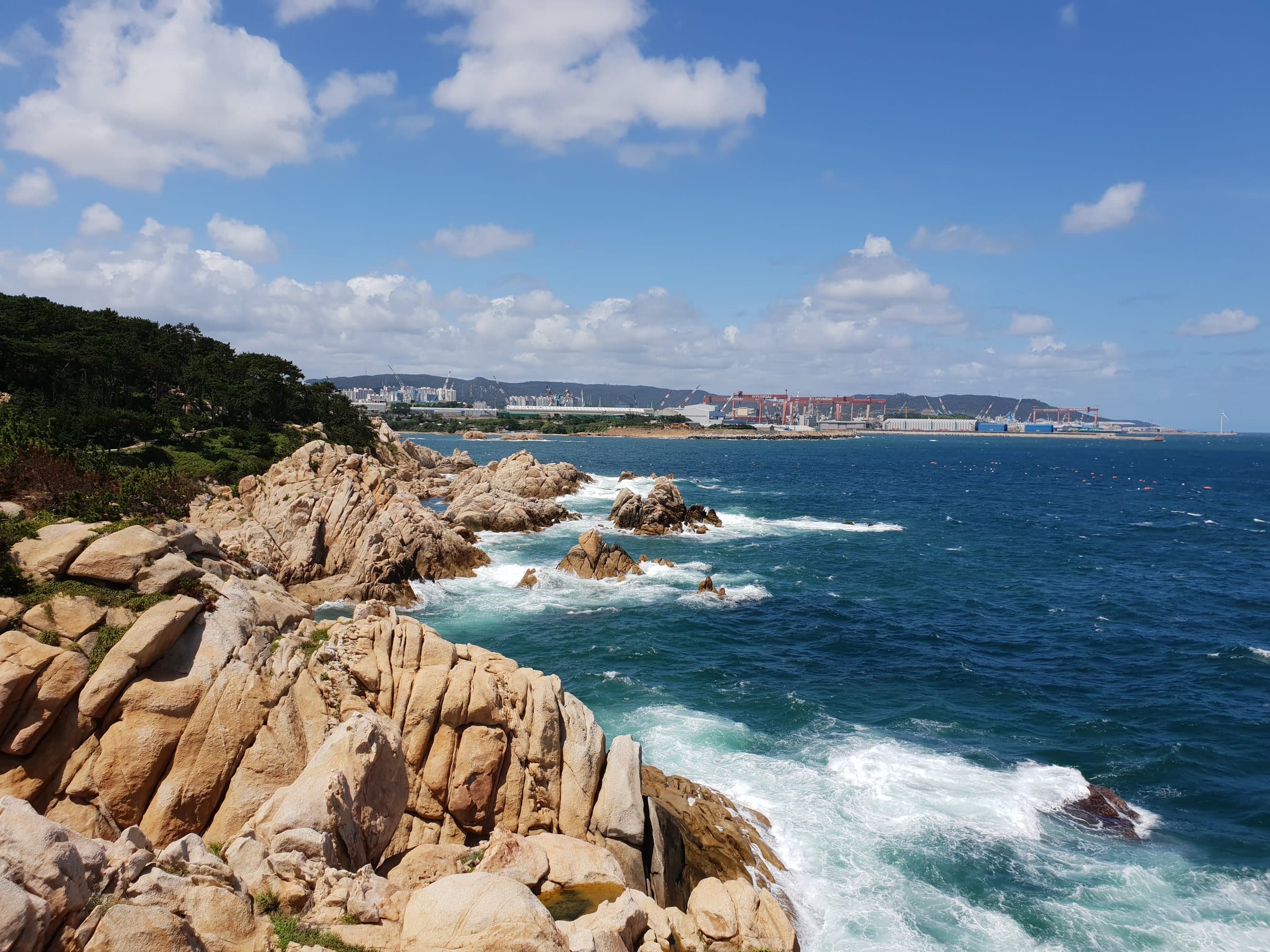
The park has two layers. Inland it is flat pine forest; seaward it is rock pushed out into the water. Walking in, a shaded pine path runs on and on until the trees end and the view opens abruptly onto stone and sea. That contrast is what the place is. Walking only the forest path and turning back means seeing half of it — going all the way out to the rocks is worth it.
The rock is granite with a reddish cast. Long work by wave and wind has left the surfaces coarse and the edges sharp, with masses standing at odds with one another. Bridges and decking thread between them so you can cross the rocks to look. Note that some seaward stretches have no railing and the stone is slippery when wet; on days with heavy surf, staying back from the outer rocks is the safer choice.
There is a story behind the name. The widely repeated account is that the queen of King Munmu of Silla became a dragon after death and settled beneath this rock, which is why it is called Daewangam, the great king's rock. A separate Daewangam off Gyeongju is known as Munmu's underwater tomb, so the two are easily confused; the Ulsan one is told through the queen. Either way, this is better treated as a long-told story than a documented fact.
The pine grove is worth the visit on its own. Sea pines grown into the coastal wind have bent trunks, and the interior of the wood stays cool even in summer. The paths are gentle enough for a long walk. It is also known for sunrises, since Ulsan lies at the eastern edge where the sun arrives early on the peninsula. Ulgi Lighthouse stands nearby and pairs naturally into the same route.