Noodles · Nationwide
Kongguksu
kongguksu
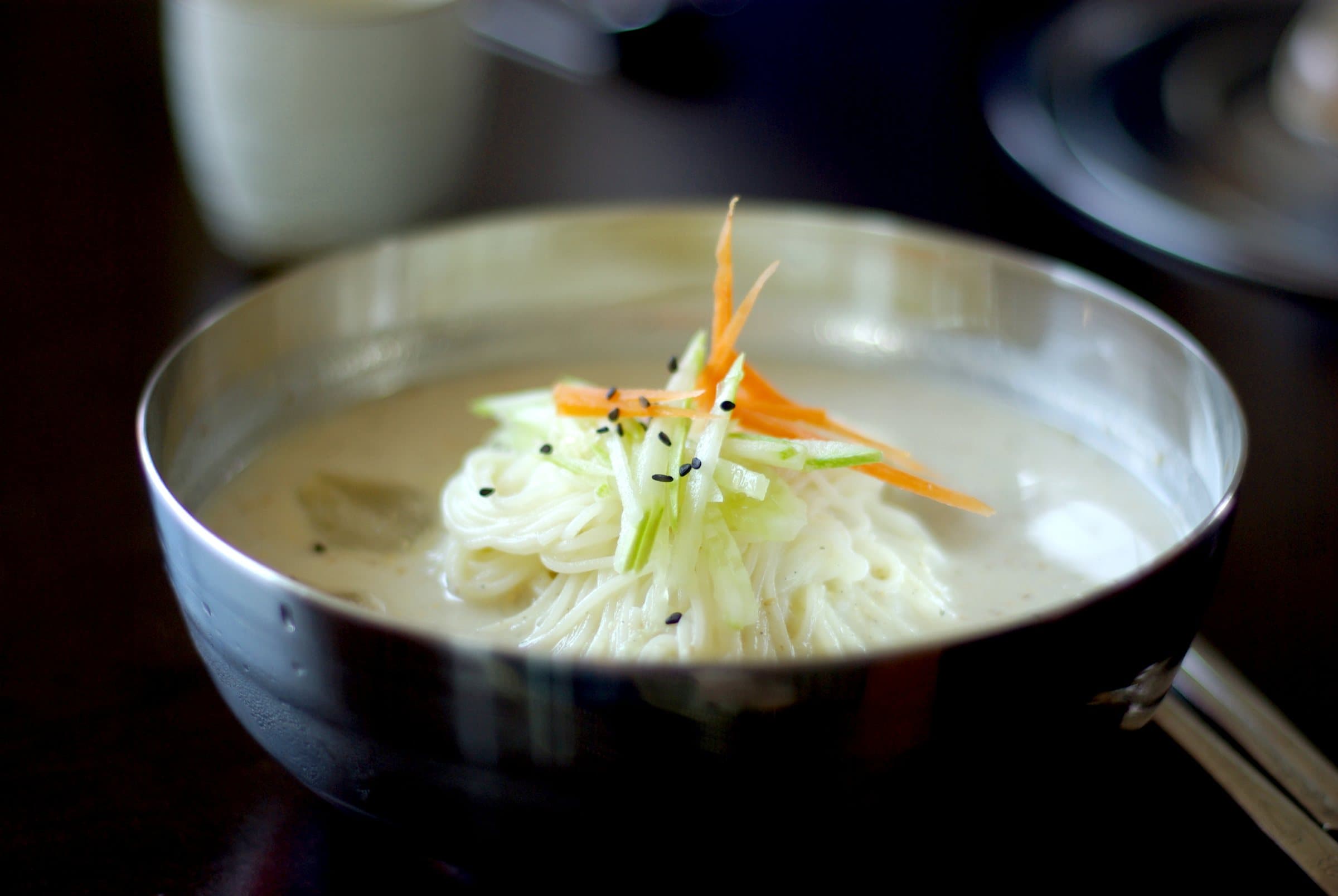
© Wikimedia Commons / egg (Hong, Yun Seon) · CC BY 2.0
Kongguksu is a summer dish of noodles in a chilled broth of finely ground boiled soybeans. There is no meat and no stock — the soybean alone makes the liquid, so the quality of the beans and how finely they are ground become the flavour directly. Many places serve it unseasoned for you to salt yourself, and in some regions people add sugar instead, a habit that reliably starts arguments.
The ingredient list is remarkably short. Soak soybeans, boil them, slip off the skins, grind them fine with water, and that liquid is the broth. That is all of it. With no stock and no seasoning stage, there is nowhere to hide: undercook the beans and a raw note lingers, overcook them and the nuttiness goes, grind them coarsely and the texture rasps. Kongguksu is a good argument for the idea that the simpler the dish, the more visible the cook.
Many places grind a few nuts or seeds in with the beans for depth. Pine nuts, peanuts or toasted sesame make the broth richer and shift the colour slightly. These are strictly supporting players; the soybean is the dish. Consistency varies widely too — some serve it thin as water, others thick enough to hold a spoon upright. The thicker version generally satisfies more, and it also uses considerably more beans.
Salt is the usual seasoning. In some regions, though, people take it sweet with sugar, and that split is a well-known running argument. Neither side is wrong so much as differently accustomed, and both habits have long histories. If it is your first time, try a little salt first, then a very small amount of sugar for comparison. Soybean broth is faintly sweet on its own, so sugar pushes that sweetness to the front.
Thin somyeon is the most common noodle. Because the broth is cold, rinsing the boiled noodles repeatedly in cold water to strip the starch and firm them up matters a great deal. Skip the rinse and released starch clouds the broth while the noodles swell. Cucumber julienne, a boiled egg and sesame on top is the standard finish. Plenty of restaurants run it as a summer-only item, so it appears when the heat arrives and vanishes when the air turns cool.
What comes with it
- Salt — most places serve it unseasoned, so adjust in small increments.
- Sugar — sweet is the regional alternative. If you try it, start with very little.
- Cucumber julienne — almost always on top; the crunch contrasts the soft broth.
- Boiled egg — half an egg is the usual garnish, adding richness.
- Young radish kimchi — a common summer pairing whose acidity resets the palate.
How to eat it
- 1Taste the broth alone first. Knowing the beans is what makes seasoning sensible.
- 2Add salt in small steps — the broth is faintly sweet, so even a little makes it bloom.
- 3Loosen the noodles thoroughly in the broth; a clumped nest never coats evenly.
- 4Take cucumber with each mouthful. The crunch against the smooth broth keeps it interesting.
- 5Drink the remaining broth. Ground from beans, the liquid is the dish, not a leftover.
FAQ
Salt or sugar?
Both are long-standing habits. Salt is more widespread, but some regions take it sweet. If it is your first time, add a little salt, then a very small amount of sugar and compare.
Is there milk in the broth?
None. Boiled soybeans ground fine with water produce that milky liquid on their own. Some places grind in pine nuts, peanuts or sesame for depth, but the base is soybean alone.
Why is it only sold in summer?
Because it is eaten cold. Soybean broth spoils easily, so many kitchens grind it fresh each day, and it suits a heat-dulled appetite — which is why it usually runs as a seasonal item.
Why is it thick at some places and thin at others?
It is the ratio of beans to water. More beans means a thicker, nuttier broth and a higher cost. Neither is the correct version; it is a choice the restaurant makes, and most diners prefer the thicker one.
Pair it with a visit
More dishes to try
태그